Thursday, 24 March 2022

Pop Rock/Psychedelic Pop : Mortimer - Mortimer (1968) (2006 Rev-Ola, 6 Bonus Tracks)


Mortimer was a short-lived psych-pop group that originally hailed from New York. In 1968, the bandmembers found themselves in London, working with record producer Daniel Secunda (brother of Procol Harum manager Tony Secunda) after signing a production deal with Secunda's B.B. & D. Productions, Inc. The group's self-titled album, from which two singles were released, was released by Philips. There are several standout tracks, including the Baroque "Where Dragons Guard the Doors" and the softer vocal harmonies of "Singing to the Sunshine" and "Life's Sweet Music." Bryan Thomas, allmusic.com)

The album has quite a few highlights. In contrast to the original album, six more bonus tracks are included here. Enjoy! (Frank)


Flac

mp3@320

pass: SB1


Australian Rock/Pop/ Power Pop/Pop Rock: Zoot - Archeology (2018 EMI Music Australia)


For the release of Zoot's inaugural single, "You Better Get Going Now," the band draped themselves, as well as the gaudy Berties discotheque venue, in bright pink. Pushing the slogan "Think Pink -- Think Zoot," the band would later burn their pink suits and bare their backsides in an act of defiance that ultimately was unable to resurrect their forever pink-stained careers.


Forming in Adelaide, South Australia, in 1966 and calling themselves "Down the Line," a soon re-badged Zoot achieved local fame on the dance scene before moving to Melbourne in 1968. Shortly after their pink-fuelled launch, their second single, "One Times, Two Times, Three Times, Four," peaked at number 32 on the Melbourne charts and the band began playing the Melbourne TV show Uptight regularly. 

Their next single, "Monty and Me," hit number one in Brisbane and the band, along with local contemporaries the Valentines, the Flying Circus, and New Dream, developed a strong teen following with their blend of disposable pop.


Replacing guitarist Roger Hicks with Rick Springfield saw the band's sound begin to mature, and they toured with the cream of Australian pop on the national Operation Starlift Tour in September 1969. They ended the year by being voted Top Australian Group in Go-Set magazine's Pop Poll.

Despite burning their former pink outfits for the cameras and baring their backsides for Go-Set, their next single, "Hey Pinky" (April 1970), failed to chart. Nevertheless, the band placed second to the Flying Circus in Hoadley's National Battle of the Sounds final in July 1970 and released their debut album, Just Zoot, the following month. The band achieved their biggest hit with their next single, a cover of the Beatles' "Eleanor Rigby," which peaked at number four on the national charts in March 1971.

The single later achieved gold status after being re-released by EMI in 1979 and Zoot formed a reputation for performing heavy covers of well-known songs. Zoot's next single, "The Freak," failed to achieve chart success and, still haunted by their former teen-star status, the group disbanded in May. Several of the bandmembers continued successful careers in music and film, including Rick Springfield, who went on to achieve international success as a singer and actor in the U.S. (Brendan Swift, allmusic.com)


pass: SB1


Wednesday, 23 March 2022

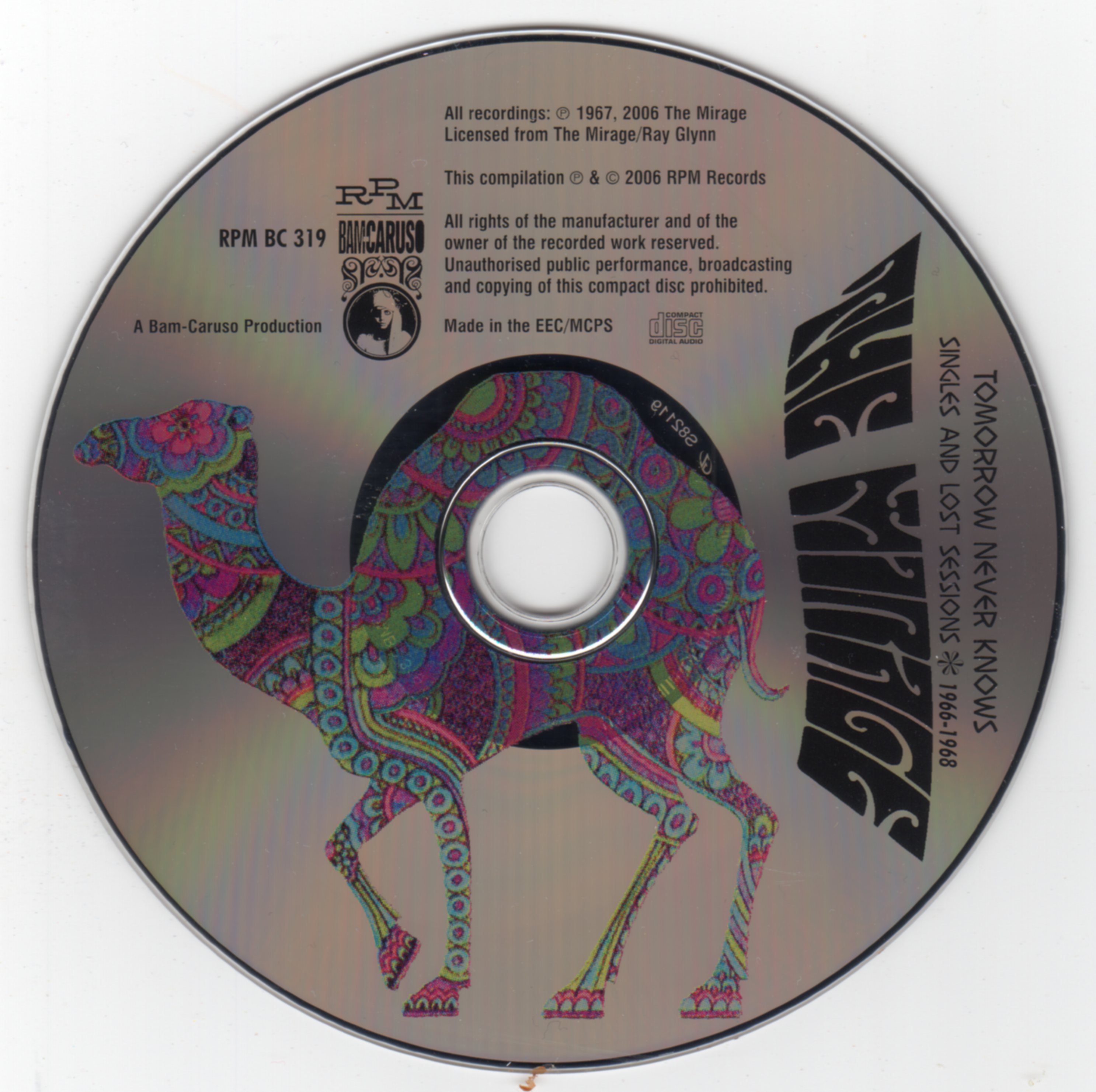
Psychedelic Pop, Beat, Pop Rock: The Mirage - Tomorrow Never Knows - Singles And Lost Sessions 1966-1968 (2006 RPM, Bam Caruso)


Although an unauthorized Mirage CD compilation (You Can't Be Serious) combining some of their singles with unreleased material made its appearance around 2000, this official anthology is preferable for its better sound quality and thorough liner notes. Tomorrow Never Knows -- The Pop Sike World of the Mirage: Singles & Lost Sessions is still not a complete document of the group, featuring just six of the tracks that appeared on their eight singles (some of which were issued under different names than the Mirage), though it does offer a whopping 17 unreleased cuts, some of which didn't show up on You Can't Be Serious.

As a band obviously inspired by the Beatles, the Hollies, and to a lesser degree by the Who and the Kinks, the Mirage were more convincing emulators than most, though they still weren't as original or as inspiring as their role models. The best comparison might be to the Hollies as they were moving from British Invasion pop to psychedelia-influenced pop -- there's more ambition at work here than the average British Invasion group, but it's not nearly as far out or cutting edge as the Beatles and the Who were by the late '60s. 

If you're looking for comparisons, some of them are in-your-face; "You Can't Be Serious" can't fail to bring to mind "Nowhere Man"-era Beatles with a dash of the Hollies. Meanwhile, the demo of "Lazy Man" is a rip-off of "Rain"; although it was rearranged so that the similarity was far more subtle by the time it had been re-recorded for a 1967 single, the rearrangement in turn borrowed heavily from the Who circa "Happy Jack." There's also their brave interpretation of "Tomorrow Never Knows" for a 1966 single, and while that track has its novelty value as a cover of a Lennon-McCartney tune rarely done by other artists, its far more basic rock arrangement can in no way stand up to the brilliant psychedelic original.

The Mirage's strongest suit was probably their slightly spooky, almost churchy story-songs, like "The Wedding of Ramona Blair" (the most famous of their official 45s among '60s collectors) and "Mrs. Buzby." These are strong enough to make this release of some interest to those who treasure that time when British Invasion pop/rock, mod, and psychedelia crossed to some extent, though the Mirage were more competent executors of those trends than innovators. (Richie Unterberger, allmusic.com)

Of course, you can't compare The Mirage with The Beatles, but nevertheless The Mirage were far away from pure copying. With their songs they made a charming contribution to the psychedelic pop of the sixties. Enjoy! (Frank)


pass: SB1


Tuesday, 22 March 2022

Rock/Pop/Beat/Pop Rock: The Zombies - The BBC Radio Sessions (Varèse Sarabande) 2016


Aside from the Beatles and perhaps the Beach Boys, no mid-'60s rock group wrote melodies as gorgeous as those of the Zombies. Dominated by Colin Blunstone's breathy vocals, choral backup harmonies, and Rod Argent's shining jazz- and classical-influenced organ and piano, the band sounded utterly unique for its era. Indeed, the Zombies' material -- penned by either Argent or guitarist Chris White, with unexpected shifts from major to minor keys -- was perhaps too adventurous for the singles market. To this day, they're known primarily for their three big hit singles, "She's Not There" (1964), "Tell Her No" (1965), and "Time of the Season" (1969). Most listeners remain unaware that the group maintained a remarkably high quality of work for several years. The Zombies formed in the London suburb of St. Albans in the early '60s, and didn't actually entertain serious professional ambitions until they won a local contest, the prize being an opportunity to record a demo for consideration at major labels. Argent's composition "She's Not There" got them a deal with Decca, and the song ended up being their debut release. It was a remarkably confident and original first-time effort, with a great minor melody and the organ, harmonies, and urgent, almost neurotic vocals that would typify much of their work. It did well enough in Britain (making the Top 20), but did even better in the States, where it went to number two.


In fact, throughout their career, the Zombies would experience a lot more success across the waters than they did at home. In early 1965, another piece of classic British Invasion pop, "Tell Her No," went into the Top Ten. Yet that was as much Top 40 success as the group would have for several years. The tragedy was that throughout 1965 and 1966, the Zombies released a string of equally fine, intricately arranged singles that flopped commercially, at a time in which the chart success of 45s was a lot more important to sustain a band's livelihood than it would be a few years down the road. "Remember When I Loved Her," "I Want You Back Again," "Indication," "She's Coming Home," "Whenever You're Ready," "Gotta Get a Hold of Myself," "I Must Move," "Remember You," "Just Out of Reach," "How We Were Before" -- all are lost classics, some relegated to B-sides that went virtually unheard, all showing the group eager to try new ideas and expand its approaches. What's worse, the lack of a big single denied the group opportunities to record albums -- only one LP, rushed out to capitalize on the success of "She's Not There," would appear before 1968.Their failure to achieve more widespread success is a bit mystifying, perhaps explained by a few factors. While undeniably pop-based, their original compositions and arrangements were in some senses too adventurous for the radio. "Indication," for instance, winds down with a lengthy, torturous swirl of bitter organ solos and wordless, windblown vocals; "Remember When I Loved Her," despite its beautiful melody, has downbeat lyrics that are almost morbid; "I Want You Back Again" is arranged like a jazz waltz, with the sorts of sudden stops, tempo shifts, and lengthy minor organ solos found in a lot of their tunes. The Zombies were also, perhaps unfairly, saddled with a somewhat square image; much was made of their formidable scholastic record, and they most definitely did not align themselves with the R&B-based school of British bands, preferring more subtle and tuneful territory.


By 1967, the group hadn't had a hit for quite some time, and reckoned it was time to pack it in. Their Decca contract expired early in the year, and the Zombies signed with CBS for one last album, knowing before the sessions that it was to be their last. A limited budget precluded the use of many session musicians, which actually worked to the Zombies' advantage, as they became among the first to utilize the then-novel Mellotron to emulate strings and horns.

Odessey and Oracle was their only cohesive full-length platter (the first album was largely pasted together from singles and covers). A near-masterpiece of pop/psychedelia, it showed the group reaching new levels of sophistication in composition and performance, finally branching out beyond strictly romantic themes into more varied lyrical territory. The album passed virtually unnoticed in Britain, and was only released in the States after some lobbying from Al Kooper. By that time it was 1968, and the group had split for good.

The Zombies had been defunct for some time when one of the tracks from Odessey, "Time of the Season," was released as a single, almost as an afterthought. It took off in early 1969 to become their biggest hit, but the members resisted temptations to re-form, leading to a couple of bizarre tours in the late '60s by bogus "Zombies" with no relation to the original group. By this time, Rod Argent was already recording as the leader of Argent, which went in a harder rock direction than the Zombies. After a spell as an insurance clerk, Colin Blunstone had some success (more in Britain than America) in the early '70s as a solo vocalist, with material that often amounted to soft rock variations on the Zombies sound.

Much more influential than their commercial success would indicate, echoes of the Zombies' innovations can be heard in the Doors, the Byrds, the Left Banke, the Kinks, and many others. After a long period during which most of their work was out of print, virtually all of their recordings have been restored to availability on CD. Blunstone and Argent reunited for an album, Out of the Shadows, and toured together in 2003 as Blunstone & Argent, playing live shows into 2004 when they began gigging again as the Zombies, with an album and DVD set, Live at the Bloomsbury Theatre, appearing under that name in 2005. To honor the 40th anniversary of Odessey and Oracle, the four surviving original members of the group reunited for a series of three concerts at London's Shepherd's Bush Empire Theatre in March of 2008, with a CD and DVD set of the shows hitting the market later that summer. 


A new studio album, Breathe Out, Breathe In, attributed to the Zombies featuring Colin Blunstone & Rod Argent, appeared in 2011. The moniker was pared down to the Zombies for 2015's Still Got That Hunger, an album of new tunes from a lineup anchored by Argent and Blunstone and featuring guitarist Tom Toomey, bassist Jim Rodford, and drummer Steve Rodford. The Still Got That Hunger lineup toured in tandem with the Argent, Blunstone, White, and Grundy edition, presenting a show in which the original members performed Odessey and Oracle in full, followed by a set of new material from the most recent lineup. (Richie Unterberger, allmusic.com)


Flac

mp3@320

pass: SB1


Sunday, 20 March 2022

Sunshine Pop, Folk Pop, Bubblegum: Sandy Salisbury - Do Unto Others 1969 (2003 Sound City Music)


Sandy Salisbury was a honey-voiced member of sunshine pop guru Curt Boettcher's cast of singers and players responsible for some of the finest pop records of the 1960s. Boettcher and Salisbury met up in Boettcher's group the Ballroom and found that their voices blended together magically. The Ballroom had a brief existence and soon Salisbury and Boettcher formed Millennium. Salisbury wrote songs as well as sang, and along with the other members of Millennium, he did work on Sagitarrius's classic 1967 album Present Tense as well as other Boettcher projects.


 Millennium released only one album and Salisbury soon recorded a solo record for producer Gary Usher's Tomorrow label. The record was to be called Sandy and featured most of the members of Millennium, but sadly it was never released due to problems at the label. In 2000, it was finally issued by Poptones and instantly became a sunshine pop classic. Also in 2000, Dreamsville released a CD of demos Salisbury recorded in the late '60s for his music publisher. 


These wonderful songs never saw the light of day at the time because Boettcher told the publisher he wanted them for future projects. These projects never came about because Boettcher lost favor with the music business and pretty much disappeared. So did Salisbury. It is a shame that these two released so little music at the time because there were no finer practitioners of California sunshine pop. In later years Salisbury has reverted to his given name of Graham and has written many well-received children's books. In 2005 Sandy was reissued again by Rev-Ola with the added attraction of 13 bonus tracks, five of which were previously unreleased. (Tim Sendra)


The whole clique of musicians that Curt Boettcher brought together were simply great in their field. And Salisbury was no exception. Hope you will enjoy this compilation. (Frank)


pass: SB1


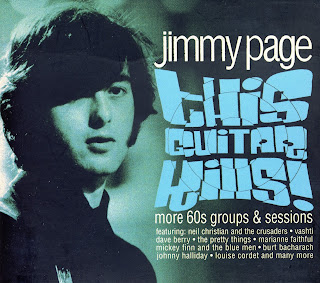
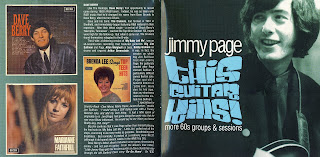
Rock, Pop, Sunshine, Psychedelic, Garage, Easy Listening: Jimmy Page - This Guitar Kills! More 60s Groups & Sessions (2003 Castle) (2CD)


Before Jimmy Page rose to guitar godhood with the Yardbirds and Led Zeppelin, he was England's premier session guitar player. His presence on a song pretty much guarantees a scorching guitar break that lifts the song up at least one notch and sometimes vaults it straight into the atmosphere. This Guitar Kills: More 60s Groups & Sessions is a follow-up to Castle's 2000 collection Hip Young Guitar Slinger & His Heavy Friends and features Page's work with a wide range of artists.


 The first disc covers the years 1962 to 1964 and is dominated by the wispy British Invasion and Brit blues sounds of Neil Christian, Dave Berry, Mickie Most & the Gear, and Mickey Finn & the Blue Men but also finds space for Page's work backing girl singers like Antoinette, Peggy Lee (whose powerful "Is It True" should have been a big hit), Louise Cordet, and Jackie DeShannon. There are also two great cuts by the Authetnics, "Without You" being a haunting beat ballad and "Climbing Through" a storming blues romp that finds Page uncharacteristically struggling to keep up with the wildness of the band he is sessioneering for.


The second disc covers the years 1965 to 1968 and features Page in a wider (and stranger) range of settings: everything from the weird fusion of big-band jazz and rock rhythms of Bobby Graham to the nasty blues-pop of Dave Berry, the Talismen, and Heinz & the Wild Boys, the wall of sunshine pop of Kenny & Deny, the girl-group sounds of Vashti and Marianne Faithful, and his appearance on a great Pretty Things track, the chiming "You Must Believe Me."


Weirdest of all have to be the easy listening orchestral selections by Burt Bacharach & His Orchestra, the Larry Page Orchestra, and the London Studio Group that feature Page's guitar doing subdued battle with a whole raft of string players. Hey, a guy has to eat. The disc rounds off with Page's appearance with Jeff Beck on the amazing "Beck's Bolero" and two very rare songs he cut with French rocker Johnny Hallyday: the trippy "Psychedelic" and the very funky "A Tout Casseer."


The two discs are just the tip of the whirlwind that was Page in the '60s. It is a very fun listen because even if a song or singer is pretty rotten Page can save the song with his fleet-fingered, wildly imaginative approach. Not quite an essential listen, but Page fans and fans of the '60s British scene should be quite happy. [Castle issued a remastered edition in 2007.] (Tim Sendra, allmusic.com)


Tim Sendra wird meiner Meinung nach der Sammlung nicht ganz gerecht. Natürlich ist sein Review positiv, trifft für mich aber nicht immer so ganz den richtigen Ton, haha. Wie auch immer.              Es gibt hier eine ganze Menge Zuckerstücke, die sich über beide Discs verteilen. So z.B. Neill Christian, Louise Cordet, Antoinette, The Pretty Things, Larry Page Orchestra, The Talismen, Kenny &Deny, Marianne Faithful, The Authentics, The London Studio Group und einiges mehr. Meiner Meinung nach sind die 'Sanctuary-Castle' Sammlungen über Page's Session Arbeiten die bis heute besten, die veröffentlicht worden sind. Man merkt dieser Doppel CD die Sorgfalt in jeder Hinsicht an. Enjoy. (Frank)


Flac

mp3@320

pass: SB1

Saturday, 19 March 2022

Pop, Psychedelic Pop: The Poppy Family - A Good Thing Lost 1968–1973 (1996 What Are Records) Remastered


A Good Thing Lost: 1968-1973 is an excellent best-of collection from the Poppy Family, a great, if largely forgotten, late-'60s Canadian soft rock/psychedelic group. The meticulous songwriting, production, and arranging skills of guitarist/mastermind Terry Jacks (who later had a huge solo hit with the classic pop single "Seasons in the Sun") lift these recordings above the work of many of the group's better-known contemporaries.


Singer Susan Jacks has a beautiful voice that sometimes sounds like (but predates) Karen Carpenter, but is eminently more soulful. Although characterized in the liner notes as a "soft pop" band, the Poppy Family was also capable of a somewhat tougher sound that sometimes recalled Surrealistic Pillow-era Jefferson Airplane and folkier material in the Kenny Rogers & the First Edition/Roger McGuinn vein. Throughout, Jacks frames the songs with creative, if often dated, arrangements that compare favorably to his obvious influences, the Beatles, the Beach Boys, and Phil Spector.


In addition to "Which Way You Goin' Billy," the group's biggest hit (number two in 1970) and a generous helping of singles and high-quality album tracks, the disc includes an alternate, wildly psychedelic mix of "There's No Blood in Bone" and two different versions of "That's Where I Went Wrong" (the second of which features some cool country guitar leads). Overall, A Good Thing Lost: 1968-1973 is a fantastic find -- one of those hidden gems that record fanatics always hope to discover. (Pemberton Roach, allmusic.com)


mp3@320 (zippy)

Flac

mp3@320

pass: SB1

Sixties Rock, Pop: Jimmy Page - Guitar For Hire - The 60s Sessions (2001 Victor, Japan)


This is not one of the usual guitar hero records where Page's guitar artistry takes center stage, but as the title suggests, He has been a session guitarist for various artists here. The compilation of the songs I personally find quite tasteful, but make up your own mind. Enjoy. (Frank)


pass: SB1
 

Thursday, 17 March 2022

Psychedelic Pop, Folk Rock, Rock: Lowell George & The Factory - Lightning-Rod Man (1993 Edsel)


Before emerging as a cult star in the 1970s, Lowell George was a presence on the L.A. folk-rock/psychedelic scene in the 1960s. With his group the Factory, he only managed to release one single during this time. Lightning-Rod Man rescues 15 tunes cut by this unit, including the single and over a dozen outtakes and demos.

Almost exclusively original material, most of these tracks were recorded in 1966 and 1967. They show the group pursuing a slightly eccentric folk-rock vision that neither bears much similarity to George's more famous work nor matches the best work done in this genre by their L.A. peers. At times they echo Kaleidoscope in their vaguely spacy, good-natured folkish rock; just as often, they take cues from Captain Beefheart and Frank Zappa in their skewed blues-rock and obtuse songwriting.


 In fact, Zappa himself produced and played on a couple of the demos, and one-time Mothers of Invention members Elliot Ingber and Roy Estrada show up on a few others. A few songs cut toward the end of the decade feature a heavier, bluesier sound that show George edging in a different direction. An enjoyable vault find, but not a major revelation. (Richie Unterberger, allmusic.com)

Nothing has changed 😉, but in some things Mr. Unterberger and I see things somewhat differentiated. But it doesn't matter.

Enjoy the music. (Frank.)

Flac

mp3@320

Alternative Flac

Alternative mp3@320

Password: SB1


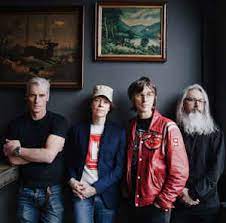
Canadian Powerpop at it's best: Sloan - 12 (Vinyl, 2018 Yep Roc, Murderecord)


12 was released a quarter-century after Sloan released their debut album, 1993's Smeared. While most bands go through plenty of changes in 25 years, this is one group that seems to have been spared the ravages of time. The four guys who founded Sloan -- Jay Ferguson (guitar and vocals), Patrick Pentland (guitar and vocals), Chris Murphy (bass and vocals), and Andrew Scott (drums and vocals) -- are still the same four guys in the band today, and their joyous fusion of power pop tunes and rock & roll guitar alchemy sounds as fresh and satisfying as it ever has.


Sloan's 2014 release, Commonwealth, focused on the four different musical personalities at work in the group, with each member writing and arranging what would have been one side on a double-vinyl release. 2018's 12 (which happens to be the group's 12th album, as well as featuring 12 songs) finds them in more unified form; 

while the advance press on the album reported each member wrote three songs for this effort, the tunes are credited simply to Sloan, and while one can spot bits of the players' individual personalities here, 12 is solidly a group effort, with the band sounding fully engaged and inspired throughout. Sloan are a band that have been able to mature without losing sight of what made them memorable in the first place;

the craft of their songwriting has grown stronger, their melodic ideas are more thoughtful, but the high-flying guitar lines and the group's brilliant harmonies are still pure pop ambrosia, both of the moment and utterly timeless. "44 Teenagers" is an unusual achievement, a song about youth written from a middle-aged perspective that's neither cloying, sentimental, nor short-sighted.

It's rare enough for an act like Sloan to endure, but it's even rarer for them to maintain a level of quality as strong as these guys; 12 proves that they refuse to simply tread water, and it's smart, heartfelt music from an uncommonly great band. If only more people outside of Canada knew just how good they are. (Mark Deming, allmusic.com)


Yes how time flies, you always see in your children...and the albums you love or maybe not.I first heard of Sloan sometime in the nineties and was immediately hooked on the band.  And that hasn't changed over the years. The band has always been able to convince me 100 percent with their powerful arrangements, in which they wrap their wonderful melodies, and still inspire me today.  The band belongs to the absolute greats in power pop, and is also a fantastic rock band. The band has a fantastic guitar sound that never makes their songs sound smooth. Cheers to Sloan,

Frank


Flac

mp3@320

pass: SB1