Monday, 10 December 2018

Psychedelic Pop/British Psychedelia From Australia: The Twilights - Once Upon A Twilight 1968 (2006 Aztec) Stereo+Mono


One of the better Australian groups of the '60s, the Twilights were not especially innovative, but played competent, harmony-driven British Invasion-styled rock, strongly recalling both the "beat" and pseudo-psychedelic era Hollies.
 Relying largely on the original material of guitarist Terry Britten, they recorded over a dozen singles, as well as a couple albums, between 1965 and 1968, chalking up a few large Australian hits. Like many Australian stars of the period, they traveled to England for a while in an attempt to crack the international market,


managing to record a few tracks in London with renowned producer/engineer Norman Smith (who had worked with the Beatles, Pink Floyd, Pretty Things, and others). Like other Australian acts in the U.K., with the exception of the Bee Gees and Easybeats, they totally failed in this regard, returning to Australia for more sporadic success in the homeland before disbanding in early 1969. (Richie Unterberger, allmusic.com)


I really love this album. No filler only killer :-) Enjoy.(Frank)

Flac
mp3@320 

US Psychedelic/Garage/Pop/Rock/andmore; Orphan Egg - Orphan Egg 1968 (2006 Radioactive)


This San Jose band earned themselves a record deal through a Vox Battle of the Bands, resulting in what’s occasionally being referred to as “a rather disappointing LP”, which I strongly disagree with.

It might be true that the particular moment in 1968 does find them still kinda searching for the real identity, jumping back-and-forth from one late’60s sub-genre to another, but one thing that certainly cannot be denied is a quite competent delivery, be it the quirky pair of Syd-through-Blue Cheer feel of the opening Falling and the just as witty ’67 Who-mor of Mourning Electra, the funked-up Rubber Soul-ful folk rocking of It’s Wrong, or harpsichord-laden Left Bank-ish harmony pop of That’s The Way Love Is and Look At Me.


Of course, there’s also a couple of pretty convincing evidences of their West Coast origins, with Deep In The Heart Of Nebraska, Circumstance and Unusual State Of Mind all being fine examples of genuine, slightlydelic r’n’beat, sometimes verging on the edge of garage-punk, that characterized the early Frisco-scene.


Unfortunately, they didn’t seem to have found the identity they were looking for, with this lone album making us believe that, otherwise, they might’ve been high contenders for one of the leading roles revolving around Hight Ashbury.(popdiggers.com)


I second the review of popdiggers. Orphan Egg were a musically absolutely competent band. In all genres or styles they had really good songs to offer. I also think the problem was that the band went in too many directions. I really enjoy the album and can only recommend it to everyone. Enjoy.(Frank)

Flac (zippy)                                                Flac (M)

mp3@320 (zippy)                                       mp3@320 (M)

                                     pass: SB1


The Yardbirds - Yardbirds '68 (2017 Jimmy Page Com.) 2 CD


...at first a few words about 'The Chords': This should be no new posting because it is already on the blog. I just wanted add new links...however...just for your information.

But now to the new post: The Yardbirds


Yardbirds '68 is a double CD and LP record album by English rock group the Yardbirds. Recorded in 1968 in New York City when the group was a quartet with guitarist Jimmy Page, it includes live performances and demos. Page produced the album, which was released in November 2017 on his own record label.


The tracks were recorded during the Yardbirds' last American tour in 1968; the live recordings are from their performance at the Anderson Theater on 30 March and studio recordings are demos from sessions at Columbia Recording Studio in April. Previously, the ten live tracks appeared on Live Yardbirds: Featuring Jimmy Page. The album was issued by Epic Records in 1971, but was quickly withdrawn. Most of the eight demos were included on the limited release Cumular Limit in 2000.


The live performance follows a typical Yardbirds' set list for the period and includes several of their best-known songs, including "The Train Kept A-Rollin'", "I'm a Man", "Shapes of Things", and "Over Under Sideways Down".


Ryan Reed of Rolling Stone noted that among the songs are three which carried over to Led Zeppelin: "Dazed and Confused", "White Summer", and "Knowing That I'm Losing You", which was later reworked as "Tangerine".


In a review for Classic Rock magazine, Ian Fortnam gave the album four out of five stars. While he has favourable comments on some of the demos, he notes "the main attraction here is the live set" that includes Yardbirds' standards and "Dazed and Confused".

 He adds that the audio has a brighter, cleaner sound than the 1971 Epic album; however, the song introductions and banter (provided by singer Keith Relf) have been unfortunately removed.


 All three surviving members of the 1968 lineup (Jim McCarty, Chris Dreja and Jimmy Page) participated in preparing the album and issued a joint statement:

    We thought this might be lost forever, but we’ve rediscovered it, re-mixed it. It’s of great historical importance. We’re delighted to see the release.(Wiki)


The double set is really well done with great artwork (DigiPak+Booklet). Five stars by me. Enjoy.(Frank)


Disc1+Artwork Flac
Disc2 Flac 
mp3@320 


Mod Revival: The Chords - So Far Away & 11 Bonus tracks 1979/1980 (1999 Captain Mod Records)


In later years, the Chords were often cursorily dismissed as little more than Jam copyists, and while there's no denying that the two groups traveled in very similar musical waters, both drawing from the British beat and Northern soul that filled their youths and sending it soaring through the prism of punk, it's there that the comparisons end. While Paul Weller coyly played footsy with both the punk and mod scenes, refusing to commit to either, there was no doubt that his soul lay with the latter, and regardless of the trio's aggressive punk-fueled delivery, his lyrics lacked punk's burning fury. Regardless of the class warfare related in "Eton Rifles," the racism reflected in "Down in the Tube Station," or the alienation of "Strange Town," no matter his country's evident flaws (and Weller etched them vividly), he still couldn't shake his love of his homeland and optimistic hope that her problems would eventually be solved. Guitarist and songwriter Chris Pope refused to see the world through the Jam's English rose-colored glasses, turning his own equally eloquent pen to scathing vignettes virtually the flip of Weller's own. In this respect, the Jam comparisons are red herrings, for if anything, Pope played the snottier, rebellious younger brother to Weller's more respectful good son.

This was apparent from the start with the Chords' debut 45, "Now It's Gone," where the group's dream of love is trampled underfoot, and driven home by its follow-up, "Maybe Tomorrow," which firmly puts the boot into the Jam's sanguine vision of Britain and turns it into a fascist horror. That single would kick off the group's sole album, So Far Away, 12 fierce tracks that defined mod's potential as punk's successor. Filled with fire and fury, the set skips from affairs of the heart to the pitiful state of the nation. Musically it's a revelation; the band's two guitarists give the group much more scope for aural assault than a trio, and with a much more aggressive rhythm section in tow, Far is as vociferous as many of its punk contemporaries. In fact, reviews threw bands like the Buzzcocks and the Undertones into the brew of the Chords' notable inspirations. For while the Chords' melodies were shaped by the '60s, their delivery was forged in punk, with even Sham 69's anthemic stomp stirred into the mix. This set reissues the stellar Far, a U.K. Top 30 album, in full, then tacks on all five of the original lineup's singles along with its B-sides, as well as the free 45 that was included with early copies of the album. The bonus tracks are helpfully sequenced in chronological order, and a full discography and excellent biography complete this phenomenal package. Of course, the two-CD This Is What They Want album made this set redundant, but if your wallet doesn't stretch that far, this will easily suffice.(Jo-Ann Greene, all music.com)

Am i in an album critic of the Jam here?????  ...''through the Jams English rose-colored glasses'' ???... hahaha. I am sorry but all i can do is shake my head about this. Where were you in '76 Jo-Ann?
Nevertheless, the album by the Chords has become a really strong album and can be recommended to anyone who loves the late seventies, early eighties mod sound.
But the Boss is Paul Weller : -).

Frank


Flac Part 1 (zippy)                                              Flac Part 1 (M)

Flac Part 2 (zippy)                                              Flac Part 2 (M)

mp3 (zippy)                                                        mp3 (M)

                                    pass: SB1


Sunday, 9 December 2018

Psychedelic/Folk/Sunshine/Garage; The Poor - The Poor 1967 (2003 Rev-Ola) Mono


Although the Poor have been portrayed as a great lost band from the 1960s, the evidence on this short collection, which brings together the four singles they recorded between 1966 and 1968, as well as two singles released by the Soul Survivors, a nascent version of the band, between 1965 and 1966, suggests that the talent certainly was there, but unfortunately not the material.


Randy Meisner (who went on to play a key role in both Poco and the Eagles), Pat Shanahan, and Allen Kemp (who both ended up in New Riders of the Purple Sage) were all members of the Poor, and the tracks here show definite potential, with beautiful, high harmonies that fall somewhere between the folk-rock feel of the Beau Brummels and the sunshine pop of the Association.


All that was really missing in the mix were some quality songs, and it's telling that a pair of Shanahan compositions, "I Can't Stand to Be in Love with You" and the delicate "Snow Man," both recorded before the Poor existed, are two of the more memorable moments here. Kemp's "How Many Tears," which sounds like a watered-down version of the Byrds (circa Gene Clark), also has its moments, as does the mildly psychedelic "My Mind Goes High" and the ornate, orchestrated "Study in Motion No. 1" (drawn from the soundtrack for Hell's Angels on Wheels) that closes the disc.


But nothing really lingers in the mind after this album ends, and while the potential of this band is clear, they ultimately didn't even come close to realizing it. By all accounts the Poor were an amazing live band, but their recorded output reveals a gifted but fairly generic group without a strong personal identity. Fans of late-'60s sunshine pop and the first stirrings of what would later become L.A.'s version of country-rock may well enjoy this set for its historical and archival value, however.(Steve Leggett, allmusic.com)


Even though this collection of songs isn't from the pop-historical league of 'Sergeant Pepper' (lol) for example, the songs of The Poor/Soul Survivors are a lot of fun for me. Good songs, well performed with really good musicians. What more do you want? ... ah yes a beer while listening would be good. Enjoy.(Frank)


Flac (zippy)                                                                            Flac (M)                                                                   

mp3 (zippy)                                                                            mp3 (M)

                                                 pass: SB1


Saturday, 8 December 2018

Soft/Sunshine/Folk/Baroque Pop; The Pleasure Fair - The Pleasure Fair 1967 (1997 Universal, Japan)


The Pleasure Fair was a musical performing group based in Los Angeles in the mid-1960s. The original group membership included Robb Royer, Tim Hallinan, Michele Cochrane and Stephen Cohn. Robb Royer obtained his first guitar when he was 19 years old and a college sophomore at San Fernando Valley State College in Northridge (now California State University at Northridge). He met Tim Hallinan at the school. "Finally, when I began playing guitar, the scales tipped and Tim saw reason to talk to me. He liked to sing and I liked to play."


The two began to perform together as "Robb & Tim" and then later added the talent of Michele Cochrane. Hallinan recalled "What I remember best about Michele was, first, that she could actually sing. I was just faking it, doing what I’ve done since I was born, an approach to life that begins with the words, 'Act like you can –' In this case, it was sing. But Michele actually could; she had a glorious voice."
Soon the trio became a quartet with the addition of Stephen Cohn, who had previously graduated from Valley State's music department, giving a senior recital in classical guitar. The group called themselves by various names, the most notable being "The Pleasure Fair" and by 1966 they managed to obtain a recording contract for a single with Hanna Barbera Records under the name "The Rainy Day People". "Junior Executive" was the "A" side, backed with "I'm Telling It To You" (both songs written by Cohn, Hallinan and Royer)


The group signed a recording contract with Uni Records in 1967 and David Gates was hired as the arranger and conductor for the Pleasure Fair's self-titled album. The album comprised twelve songs, eight of which were original compositions by Royer, Hallinan and Cohn with one additional song written by Cohn.

Royer's song "Say What You See" (co-written with Tim Hallinan) would end up in 1968 being produced by Jimmy Griffin and arranged by David Gates. It was sung by a trio calling themselves "The Curtain Calls." Soon afterward in the same year the three founding members of Bread (Royer, Griffin and Gates) would combine forces as their own group.(Wiki)


It is a pity that the band disappeared in the mass of sunshine pop/baroque and folk pop releases in 1967. The band certainly hadn't reinvented the wheel, but with this album they showed that there was a lot of potential in the band. Enjoy.(Frank)

Flac (zippy) 

mp3@320 (zippy)


Marvellous Sixties Garage/Beat/Pop From Scotland; The Poets - Wooden Spoon The Singles Anthology 1964-1967 (2011 Grapefruit)


Although they only released half-a-dozen singles, these were enough to firmly establish the Poets' status as the best Scottish rock group of the mid-'60s. It's true that this is akin to being a big fish in a small pond -- not many Scottish bands recorded in the '60s, and not many of them were at all notable. But that shouldn't detract from the genuinely high quality of their records, which still remain known only to a relatively small band of collectors.


The Glasgow group differed from most other Scottish combos of the time in that they concentrated almost exclusively on original material, which alternated between mournful, almost fey ballads and storming mod rockers. Critics have compared the melodic, minor feel of much of their work to the Zombies, a comparison that holds water to a certain point, although the Poets were far more guitar-based. A minor hit single right out of the gate and a management deal with Rolling Stones manager Andrew Oldham seemed to spell probable success. But the Poets fell victim both to subpar promotion and numerous personnel changes, which had gutted the core of the band by the late '60s.


Oldham came across the band by chance on a trip to Scotland in 1964, quickly signing them and arranging a recording deal with Decca. Their first single, a characteristically moody original called "Now We're Thru," made number 30 in the U.K. Yet that was to be their only taste of commercial success, despite a flurry of fine singles over the next couple of years.


 The two-bass throb of the hard-rocking "That's the Way It's Got to Be," the exquisite acoustic ballad "I'll Cry with the Moon," a fiery cover of Marvin Gaye's "Baby Don't You Do It" -- all are worth hearing by British Invasion fans. Although some may find their slow numbers a bit on the maudlin side, the group had a knack for fine melodies, harmonies, and dense guitar arrangements that lifted these above the ordinary.


But the Poets were never given full opportunity to develop their unquestioned skills. Oldham took the group with him to his independent Immediate label in late 1965 for a couple of singles, but ultimately the Oldham association may have worked against them, as he was naturally inclined to focus most of his energies upon the Rolling Stones. The Poets were getting lost in the shuffle and discouraged, and by 1967 not one original member remained from the lineup that had first recorded.

They did marshal the energy for a superb 1967 single, the blue-eyed soul/psychedelic "Wooden Spoon," which indicated that the band was still progressing and maturing, even though their continuity with previous lineups was tenuous to say the least. The Poets straggled on until 1971, barely recording again; Poets alumni turned up in Scottish bands like Trash (who were briefly signed to Apple Records), Marmalade, and one of Alex Harvey's outfits.(Richie Unterberger, allmusic.com)


 A really great compilation that shows what a strong band the poets were. The songs convince with authenticity, powerful arrangements and catchy melodies. The band would have deserved more than the relatively short fame they received. Enjoy.(Frank)

Flac
mp3@320


Steve & The Board - ...And The Giggle Eyed Goo 1965-67 (2000 Ascension)


The Australian band Steve & the Board made some decent if derivative British Invasion-style records in the mid-'60s, getting some success in Australia with the singles "The Giggle Eyed Goo" and "I Call My Woman Hinges 'Cause She's Something to Adore." All the members were in their late teens when they recorded for the Spin label, and their progress was no doubt eased by having a lead singer, Steve Kipner, whose dad Nat Kipner was the head of Spin Records. The group wasn't a mere manufactured boy band, though, as in fact much of their material was original, contributed by several members (though most often guitarist Carl Keats). In their blend of British R&B and pop/rock influences, their recordings were fairly solid straight-ahead rock that criss-crossed attributes of the Beatles, the Byrds, Merseybeat, and raunchier groups like the Pretty Things. They issued just one album, though, and a couple of non-LP singles. All of their sides are available on the Ascension CD reissue of the Steve and the Board ...and the Giggle Eyed Goo album, which adds the non-LP 45 cuts.


Steve & the Board's album had included a Barry Gibb song the Bee Gees never released, "Little Miss Rhythm & Blues," and one of the Keats songs on the LP, "Lonely Winter," would be recorded by the Bee Gees. The Bee Gees connections would continue in some other post-Steve & the Board careers, and in fact might be what the band is most known for. Drummer Colin Peterson would join the Bee Gees for a while in the late '60s; his replacement in Steve & the Board, Geoff Bridgeford, would himself be in the Bee Gees in the early '70s. Steve Kipner went on to be part of Tin Tin, which had a number 20 hit in 1971 with "Toast and Marmalade for Tea," and recorded a late-'70s solo album for Elektra. He's more well-known, though, as a mainstream pop songwriter, his most successful creation being "Let's Get Physical." (Richie Unterberger, allmusic.com)


A great album highly inspired by the brit invasion of the sixties. Enjoy.(Frank)

Flac (zippy)                                                  Flac (M)

mp3@320 (zippy)                                        mp3@320 (M)

                                        pass: SB1

Sixties Mod/Pop/Rock; The Attack - Magic In The Air (1992 Aftermath)


The Attack (thanks to an ever growing legion of collectors dedicated to the vibrant sound of mid- to late-'60s Swinging London) have a far larger fan base now than they ever did during their existence. Indeed their unique brand of guitar-heavy, mod-rock qualifies them as one of the finest examples of (the over used term) freakbeat. Hence over the last 15 years there has been an abundance of vinyl bootlegs and inclusions on such psychedelic/freakbeat compilations as Rubble! The founders Richard Shirman (the only original member to stay with the group throughout all of the lineup changes) and Gerry Henderson were originally in a group called the Soul System, whom, for the best part of a year, had a very unstable lineup.
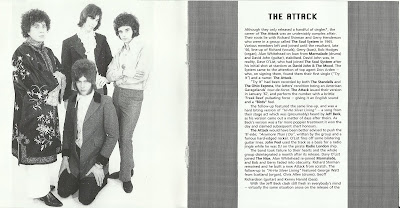

In early 1966, the remnants of the crumbling group were joined by Bob Hodges on organ, David John (not David John of David John & the Mood, but Davy O'List under alter ego) on guitar, and Alan Whitehead (on loan from Marmalade) on drums. They soon came to the attention of entrepreneur (gangster?) Don Arden, who then signed them to Decca and changed their name to the Attack. Their debut single released in January 1967 was an extremely anglicized cover of "Try It," an American hit for both the Standells and Ohio Express, whose versions were exemplar of the sneering garage sound.


However, the Attack's powerful vocals, pop art guitar, and the underbelly of a warm Hammond created a similar atmosphere to the Small Faces (also managed by Don Arden), the Birds, and the Creation. Shortly after the single was released, Davy O'List was handpicked by Andrew Loog Oldham to join the Nice (who were to act as the backup group for newly acquired American Soul singer P.P. Arnold) and quit the group in late February.


Meanwhile, Shirman, a regular visitor to the London clubs had been keeping a watchful eye on a young guitarist he had seen jamming with Jimmy Page. Shortly thereafter John Du Cann (mainstay, and songwriter) was introduced into the group. As a follow-up to "Try It," a version of "Hi-Ho Silver Lining" was then released, but Jeff Beck got the hit first in Britain in 1967. The third 45, "Created By Clive"/"Colour of My Mind," backed a foppish sub-Kinks-style number with a fairly groovy mod-psych tune penned by DuCann.


Kenny Harold (bass) and Geoff Richardson (guitar) left shortly after the disappointment of "Created By Clive," leaving John as the only guitarist. Jim Avery (who later went on to the revolutionary Third World War) was drafted in on bass, with Plug (whom later went on to Welsh acid rock outfit Man) still on drums. After yet even more disappointment surrounding the "Magic in the Air" single (Decca refused its release on the grounds of it being too heavy), Plug and Jim Avery left the ranks to be replaced by Roger Deane (bass) and Keith Hodge (drums).
The final single, released in early 1968, was "Neville Thumbcatch," a fruity mod-pop tune with spoken narration, like a lesser counterpart to Cream's "Pressed Rat and Warthog." Decca's deal with the Attack expired after that single, with a projected fifth 45, "Freedom for You"/"Feel Like Flying," remaining unreleased.(excerpt by biography, taken from allmusic.com, written by Jon Mills)

 Flac
mp3@320